Overview
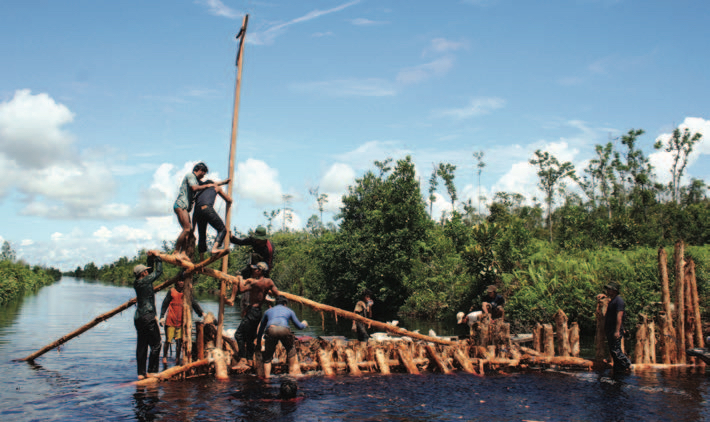
The Central Kalimantan Peatlands Project (CKPP) grew out of an increasing recognition at the local, national and international levels of the urgency of halting and reversing degradation of the peatswamp forests of Central Kalimantan, Indonesia. Drainage, illegal logging and fire have devastated the area's peatswamps in recent decades, and the impacts on local livelihoods, the broader economy and critical wildlife habitats have been staggering. Moreover, the annual contribution to global greenhouse gas emissions has been massive, as the decomposing peat releases stored CO2 at an alarming rate. In response to the mounting crisis, the CKPP was developed as a large-scale restoration programme aimed at rehabilitating these vital ecosystems and safeguarding the region's rich biodiversity. Implemented by a local five-member consortium, the project focused on damming drainage canals to restore natural hydrologic conditions, revegetating denuded areas with commercially-important native tree species, and taking steps to improve local socio-economic conditions while introducing sustainable agricultural techniques. The pilot phase completed in late 2008 provides a strong foundation for future conservation and restoration activities in Central Kalimantan and serves as a basis for other, similar activities in the rest of Indonesia and elsewhere in the tropics of Asia.Project Details
Central Kalimantan Peatlands Project
- National NGO
Central Kalimantan Peatlands Project
Adaptive management
Describe adaptive management processes and mid-course corrections taken to address unforeseen challenges and improve outcomes in each of the following categories:
The CKPP consortium has been successful in raising both local and global awareness of the problems facing peatlands in Indonesia and of their international importance as significant carbon sequesterors and climate-change mitigators. Within Indonesia, there appears to be renewed respect for peatswamps and for the environment in general. This changing perception can be noted in the reduction of illegal sawmills around forest reserves and in the increased political, public and financial support for peatland conservation. Indeed, the Provincial Government of Central Kalimantan has initiated the development of a Master Plan for Peatlands rehabilitation, and in 2007, the National Government issued Presidential Instruction No 2/2007 regarding the rehabilitation of the Ex-Mega Rice Project area.
Thanks to media coverage and consortium members' presence at key meetings, global awareness about Indonesia's peatlands ecosystems has also been raised. The relationship between peatlands and global climate change is now more widely recognised by the UN Convention on Climate Change (including REDD, the UN climate policy on Reducing Emissions from Deforestation and Degradation in developing countries), the Convention on Biological Diversity and the Ramsar Convention on Wetlands. All of these bodies made decisions in 2007 and 2008 that address tropical peatlands as a key ecosystem with high values for carbon storage.
- Closed/completed, no further follow-up
2005-12-18
2008-12-18
- Asia
- South-Eastern Asia
- World
- Indonesia
- Tropical-subtropical forests biome
- Palustrine wetlands biome
- Tropical flooded forests and peat forests
- Other
- Other
- Deforestation
- Other industrial and urban development
- Non-timber natural resource extraction (including fuelwood)
- Other forms of unsustainable agricultural practices
Unsustainable agricultural practices and logging activities pose a serious threat to the future existence of Central Kalimantan's locally and globally important peatlands ecosystems. The region has suffered severely from forest fires and excessive drainage, largely resulting from the failed Ex-Mega Rice Project (EMRP), a government-sponsored rural development program that subjected 1.4 million hectares to intensive logging and systematic drainage.
Under the EMRP, about 4,400 km of drainage canals, some up to 10 metres deep, were excavated to lower the water table across vast areas of peatland forest and convert them for agricultural production. Once these canals began to fail (e.g. buildup of organic debris, collapsing banks), work on the drainage network ceased. However, the lattice of canals quickly proved destructive for habitat conservation and management efforts, as the drainage of EMRP peatlands has precipitated major, and largely irreversible, impacts over great distances, seriously compromising the ecological integrity of the entire region. The most direct impacts include:
Drainage canals have greatly affected surface water storage and flows, over large areas. The increased drainage has caused rapid desiccation and peat humification and has removed the characteristic hummock-hollow top layer that plays an important role in keeping peatlands wet in their natural state. This has prolonged the period when water tables are below the peat surface, which in turn has caused peat decomposition and subsidence. Downstream of the peatlands, the result of drainage can be increased peak runoffs and, thus, more flooding risk.
The impact of drainage is most severe in a zone of approximately 500 metres along the canals, where subsidence and possibly fire frequency are greater, resulting in relatively steep surface slopes away from canals. Peat surface elevations 1 km from canals are now generally 0.5 to 1 m higher than the canal sides. Instead of the original low-gradient peatland landscape that functioned as a single hydrological system over tens of square kilometres, a "mini-dome" topography has developed because of drainage. This now controls the hydrology of the area.
Not only did the lattice of canals lower the water table and dry organic soils, but it also provided improved access to what were once remote and largely inaccessible forests. Illegal logging operators took advantage of the new waterways to deforest areas near the canals and to excavate lesser channels radiating away from the canals in order to remove logs from even more interior locations. Moreover, the ranks of illegal loggers swelled, as thousands of settlers relocated under the EMRP soon found the acidic and infertile soils unsuitable for agriculture and turned to logging to supplement their income. These drained, logged areas became desiccated and fire prone, and are now the scene of devastating annual peat fires.
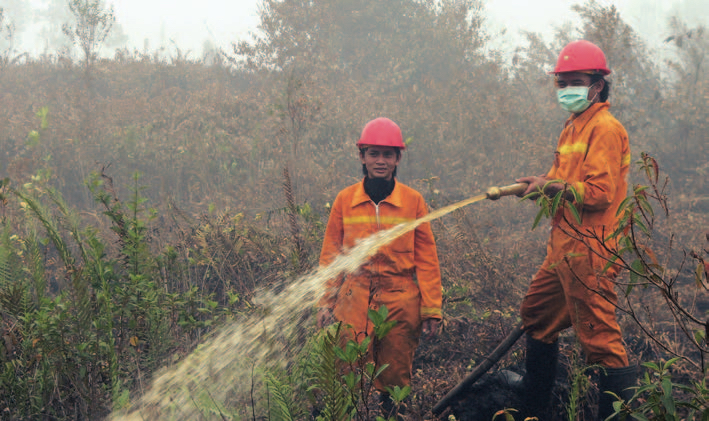
Fires in this peatland forest area can be triggered naturally through lightening strikes or by human interventions (e.g. discarded cigarettes, uncontrolled camp/cooking fires, clearance for agriculture). Fires in peatlands are devastating to the forest plant communities and structures, as well as the basic forest soils that sustain the vegetation. Unlike mineral soils in forests, organic soils are severely affected by fires, particularly when they are in a dry state. Of particular concern is the fact that fires in peatland forests can lead to massive carbon emissions, as happened in 1997 with the series of fires exacerbated by the El Niño-Southern Oscillation (ENSO) event. It is estimated that between 0.81 and 2.57 gigatonnes of carbon were released into the atmosphere as a result of burning peat and vegetation, an amount equivalent to 13-40% of mean annual global carbon emissions from fossil fuels. Many fire patterns in Indonesia are directly linked to the network of canals and ditches.
Goals and Objectives
unsure
YES
- The reference model is based on historical and contemporary information about ecological attributes at the site prior to degradation.
YES
- Other
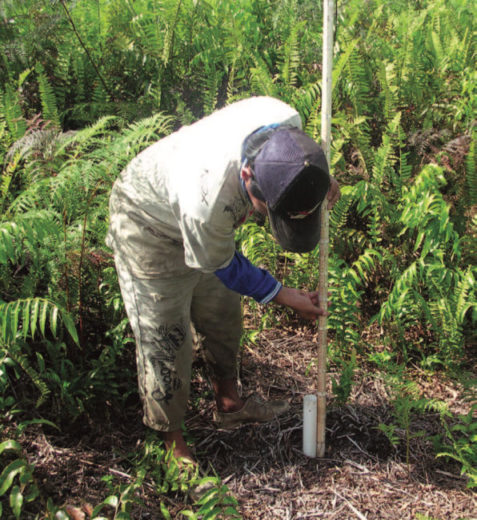
The objective of the Central Kalimantan Peatlands Project was to maintain and restore peatlands in the Sebangau National Park area, Block E (Mawas) and other parts of the Ex-Mega Rice Project (EMRP) in order to improve biodiversity conservation over approximately two million hectares. In order to meet this objective, the project focused on improving the hydrology of the peatswamp forests and degraded peatlands, regreening degraded peatlands and reducing the incidence of and damage by fires.
Ecosystem Activities and Approaches
- Ecological restoration
- Assisted natural recovery with planting, seeding, or faunal introductions (e.g. enrichment planting or seeding; farmer assisted natural regeneration; rewilding)
- Restoration of vegetation cover and ecosystem structure
- Soil and water management
- Tree planting
- Grading to establish topography
- Restoration of wetland hydrology
- Mix of native species
Long Term Management
- Other (please provide details)
The CKPP is a first step towards the restoration and sustainable use of peatlands in Central Kalimantan and throughout Indonesia. The successes of the project set an important example, but are still relatively minor in comparison to the scale and intensity of problems and challenges of peatland exploitation in the area. There is a clear need for replication and expansion of restoration activities over a broader geographic context, and completion of the Master Plan for over one million hectares of the EMRP will be the next step in stimulating the long process of rehabilitation and revitalisation of the troubled area.
The CKPP brokered a deal between the Government of the Netherlands and Indonesia to develop this Master Plan. The contents of the document are still relatively general, underlining policy issues and providing guidance, and it will undoubtedly be discussed, reviewed and revised in accordance with developments over time, improvements in the science base, and changes in national and international policy frameworks and in the local situation. Nonetheless, the following recommendations have been made to orient future peatlands management activities both in Central Kalimantan and beyond:
--The results of the Master Plan in relation to structure, management and use of the EMRP area should be integrated and synchronised with the ongoing revision of the spatial plan of Central Kalimantan Province. This will provide the Master Plan with increased legal authority.
--Strategies and detailed action plans should be developed for sectoral and inter-sectoral peatland management (conservation, agriculture, transmigration, forestry, fisheries, health, tourism, etc.). Institutional structures need to be developed and enhanced to effectively and economically implement this management system.
--The pilot activities implemented by CKPP remain relevant and in line with the needs and priorities of Central Kalimantan. Further diversification will be useful, particularly with regard to emerging opportunities such as REDD, Bio-rights, biodiversity offset mechanisms and payment for environmental services.
--Project monitoring should be improved, and involve developing a detailed monitoring protocol, regular independent monitoring and evaluation of approaches, field activities and outcomes, as well as establishment of specific monitoring systems for defining and measuring impacts. Regular project monitoring should be implemented by task groups under the Scientific and Technical Advisory Committee, augmented by annual independent monitoring and evaluation surveys.
--A REDD methodology for reducing peat degradation related to emissions should be developed in the context of international developments in this regard. Local capacity should be developed for REDD methodology implementation, especially the monitoring of emissions and water levels in line with scientific and market requirements.
--The CKPP Board should include representatives of other major peatland projects to ensure coordination among donors, optimise synergies, avoid duplication and overlap and ensure that project plans relate appropriately to the local absorption capacity.
--The CKPP Board should ensure the longevity of financial mechanisms to enhance the security for local stakeholders. One of the key difficulties in resolving the unsustainable land use issues in Indonesia's peatlands is the lack of sustainable finance mechanisms and coherent finance strategies to support an integrated approach to poverty reduction, environmental management and biodiversity conservation. In the follow-up to the Bali roadmap, and also as a result of CKPP and Master Planning, bilateral donors are now paying much more attention to peatland issues in Central Kalimantan. This was not the case at the beginning of the project. However, the high interest in this particular area also carries the danger of exceeding the absorption capacity, and there is an increased need for donor coordination. Moreover, current project-by-project funding does not provide the financial security needed for local stakeholders to change their livelihood and investment strategies. There is a clear need for guarantees of a long-term sustainable funding flow that will enable the longer-term investment strategies that are essential for achieving conservation and sustainable development. The potential of innovative mechanisms such as voluntary carbon markets, REDD funding, Payments for Environmental Services, Bio-rights and Bio-diversity offsets, offer great potential for supporting government-led as well as community-based approaches to enhancing the sustainable management and conservation of these critical carbon stores and high biodiversity areas. There is now a need for international and local systems for managing funding flows in a way that guarantees accountability and transparency requirements and can ensure the equitable allocation of carbon rights and carbon funding, empowers local stakeholders and achieves maximum participation of the poor. None of these mechanisms exist at present. Yet these will be needed for gaining the necessary support of the local communities. With the emergence of a broadly shared understanding of the need for these innovative systems, and a global awareness of joint synergistic targets (e.g. climate change mitigation, biodiversity conservation and poverty reduction), there is a window of opportunity that has not existed before. Indonesia, and the peatlands of Central Kalimantan in particular, can provide an excellent basis for developing, testing and promoting these.
STAPER
- A1. Assess degraded ecosystems
- A2. Identify/prioritize locations for meeting national contributions to Aichi Targets
- A3. Involve all relevant stakeholders