Overview
The 2010 State of Parks Report for Cape Breton Highlands National Park identified the forest indicator was in “Fair, Declining” condition, with boreal components of the indicator in “Poor and Declining” conditions. Past large scale disturbance due to spruce budworm outbreak killing off mature trees, combined with high moose populations (> 2 moose/km2) suppressing regeneration, disrupted normal forest succession processes. This resulted in approximately one third historic boreal forest area loss, converted to grassland (~12% of park area). Exclosures established in 2007 on North Mountain and French Mountain demonstrated that natural boreal regeneration potential differed among sites within these grasslands, suggesting that a single management solution would not be sufficient to re-establish boreal health to Cape Breton Highlands National Park.
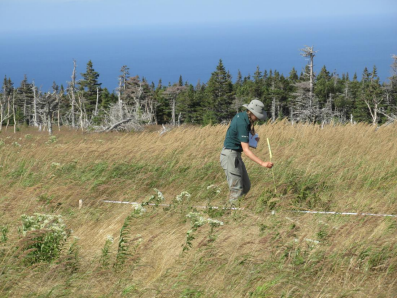
Following extensive public and stakeholder consultation, Cape Breton Highlands National Park sought to test, adapt, and integrate the Gros Morne and Terra Nova national parks moose population reduction program models. In collaboration with the Mi’kmaq of Nova Scotia, the model was applied to areas with natural regeneration potential to a small test area (20 km2) of the park. This model was combined with active reforestation, planting seedlings, and testing the use of exclosures to kickstart, and protect forest regeneration on Skyline trail where natural succession has been disrupted. These tests were to inform future landscape level management activities throughout Cape Breton Highlands National Park. Extensive Visitor Experience and media outreach programs were employed to inform the public and park visitors of the program and boreal ecology. From 2015-2018 a total of 138 moose were harvested from the test area on North Mountain, with between 64% - 97% animal removal each year. Monitoring of recovery potential in the harvest zone has been promising, with relative availability of unbrowsed twigs on palatable species rising from the baseline of 46% in 2015, to 86% in 2019. Bring Back the Boreal planted over 16,000 trees along Skyline trail through interpretive and volunteer programs. Experimental planting of an additional 51,000 trees has resulted in 3.6 ha of surviving high density (>7000 stem/ha) regeneration of white spruce and balsam fir in proximity to Skyline trail. A viewing platform within the exclosure, with interpretive panels received over 61,000 visitors in its first two years of operation. Two YouTube videos, and a project website, have resulted in over 33,000 hits for the project, and a webcam established on the Skyline exclosure viewing platform has had almost 57,000 visits in its first year of operation. Outreach associated with the project has resulted in over 4,000 volunteer hours, and engaged 19 partners. This resulted in closer relationships with academic partners, multiple new partnerships, and strengthened relationships with other existing partners. Media coverage of the project has been extensive with 273 hits, ranging in scope from national media to letters to the editor, and has primarily focused on the harvest. Since 2015 the proportion of negative media hits has shrunk from 52% to only 3%. Bring Back the Boreal has been a major theming component in Cape Breton Highlands National Park, and has helped shape visitor experience since 2014. The project can be credited with transforming how the public views boreal ecosystem restoration in the Cape Breton Highlands. The successes and lessons learned from this project will be used by Parks Canada and partners, to inform park management plans and future conservation efforts centered on landscape level boreal forest recovery. The project has demonstrated the potential for ecological integrity recovery of this major ecosystem with proper management and cooperation with partnering agencies.
Project Details
Parks Canada CoRe
- National Government
Mi’kmaq of Nova Scotia and Unama’ki Institute of Natural Resources (UINR), Nova Scotia Webcams, Nikani Awtiken Mi’kmaq youth camp and Nova Scotia Community College (NSCC) environment technology, Forestry, and the Natural Resources Engineering Technology (NRET) programs, Cape Breton Highlands National Park, and NS Department of Lands and Forestry
Adaptive management
Describe adaptive management processes and mid-course corrections taken to address unforeseen challenges and improve outcomes in each of the following categories:
https://www.pc.gc.ca/en/pn-np/ns/cbreton/decouvrir-discover/conservation/foret-forest
- Implementation activities complete, monitoring ongoing
2014-04-01
2019-03-01
- National government and public institution
- Private companies, landowners
- Other
- Ecological crisis (e.g., drought, flood, storm damage, fire)
- Expected ecological or biodiversity benefits
- Other motivation
The Bring Back the Boreal project was designed to address the two primary impediments to boreal forest regeneration in Cape Breton Highlands National Park; overbrowsing by moose, and persistent replacement of seedlings by grasses, with the end goal of creating conservation gains within the boreal forest ecosystem of Cape Breton Highlands
- Northern America
- Canada
- Temperate-boreal forests and woodlands biome
- Boreal and temperate high montane forests and woodlands
- Ownership public (government)
- Other (please provide details)
- 1-10 ha
- 1-10 ha
- Deforestation
- Invasive species
- Other
Overgrazing from abundant introduced moose populations
- Other
Past large scale disturbance due to spruce budworm outbreak killing off mature trees
Planning and Review
- Project team includes partner experts in key areas (e.g., restoration ecology, social science, engineering, prescribed fire, invasive species, seed-based restoration)
- Project incorporates appropriately acquired Indigenous and local knowledge (ILK)
- Assessment of local and regional context to facilitate alignment of project goals and objectives with factors operating at the landscape/seascape scale.
Goals and Objectives
YES
- Landscape context and spatial analysis (e.g. the relation of the site to its surrounding landscape or aquatic environment, potential for beneficial ecological exchanges, opportunities to integrate the project with local and regional conservation and sustainability goals and priorities)
- Species composition, including threatened and invasive species
- Degradation drivers and threats
- Ecosystem functions (e.g. productivity, recruitment, disturbance regimes)
- Relative capacity of the biota on site or external to the site to commence and continue recovery without assistance
UNSURE
YES
- Culture: Practices
- Culture: Values
- Culture: Rights
- Biodiversity: Quality
- Biodiversity: Connectivity
- Biodiversity: Protection
- Ecosystem: Integrity
- Ecosystem: Functionality
Stakeholder Engagement
YES
- Individuals
- Local communities
- Local community groups and nonprofits (civil society)
- Local government
- State and provincial government
- National government
- Other
- Common concerns are defined prior to intervention
- The restoration project is defined from an ecological, social and economic point of view
- Local communities
- Indigenous people
Ecosystem Activities and Approaches
- Rehabilitation
- Ecological restoration
- Assisted natural recovery with planting, seeding, or faunal introductions (e.g. enrichment planting or seeding; farmer assisted natural regeneration; rewilding)
- Restoration of vegetation cover and ecosystem structure
- Control of invasive species
- Grazing management (e.g. control of native grazer populations; reductions, removal, or exclusion of nonnative grazers)
- Tree planting
- Species control measures, physical or mechanical (e.g. cutting, pulling, burning, covering, digging up, plowing, scalping, mowing, capturing, hunting)
- Mix of native species
- Unknown
- Seedlings, very young individuals
Monitoring and Data Sharing
YES
- The monitoring program was or is being used to apply lessons learned to adaptive management within and across programs
- The monitoring program has the proper timing, frequency, and duration so that lessons learned can be applied to adaptive management
- Monitoring questions are directly linked with restoration objectives
- <1 year
- Public institute
- Other
- Collection of project data (e.g. number of volunteers, training, funding)
- Counts of individuals of introduced plants or animals
- Other (please provide details)
Engagement with park users, counts of social media/website views
- National government and public institution
- Project or organization website
- Social media
- On own or collaborator’s website
- Other (please provide details)
Parks Canada Agency. 2016. Bring Back the Boreal: restoring forest health to the highlands, Cape Breton Highlands National Park. Detailed Project Description 2014-2019. Ingonish Beach, Nova Scotia: Parks Canada.
Long Term Management
- National government resourcing